
Marily, Maria Victoria Bioti Xaga, was born in Buenos Aires, Argentina in 1956 and at the age of six had her first contact with painting. Her teacher recognized her talent early on and at the age of nine encouraged her to take exams at the School of Pan-American Studies, where she succeeded and began her studies. One of her teachers was Benito Quinquela Martín, elements of whom can also be found in Xaga’s color palette. In addition to her art studies, Marily Xaga is a graduate of Economics at the University of Buenos Aires (UBA). She has lived and worked in Greece since 1977 and has held many exhibitions in Greece and abroad. In 1987, she was awarded in Tripoli, Libya, at the Peace and Cooperation Conference for her contribution to portrait painting. She is the first female painter to have a work in the Throne Room of the Archdiocese of Athens (portrait of the Archbishop of Greece, Mr. Iakovos). Her paintings adorn Embassies in Athens, homes and offices of important political figures, Metropolitans and her works are in museums and private collections in Greece and abroad. Although the artist is known for her portraits, she also creates works whose themes are drawn from theology, philosophy and history of Greece, always utilizing the classical style.
The Tripoli collection includes the painting “Kolokotronis in Bed” (2015), which is inspired by Pierre Bonirote’s pencil drawing, “The Funeral of Kolokotronis”: this is Xaga’s second oil painting based on this particular drawing. The first, painted the same year, was awarded and given to the former President of the Hellenic Republic, Mr. Prokopis Pavlopoulos, and is currently in the Athens Museum. In both works, Kolokotronis is depicted lying on his deathbed in the same position; however, the artist uses different tones of her color palette in order to convey different emotions in the painting located in Tripoli. In this work, while the artist’s basic palette is the same (red, blue, black, yellow and white), her brushstrokes are soft and the colors darker in tone so that she can transport the viewer, with mystery and calm, to the moment of Kolokotronis’ death.
-

Kolokotronis in his Deathbed
-
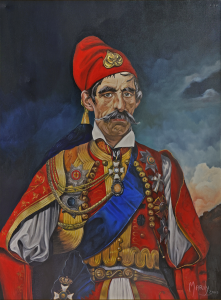
Portrait of Giannis-Gennaios Kolokotronis
-
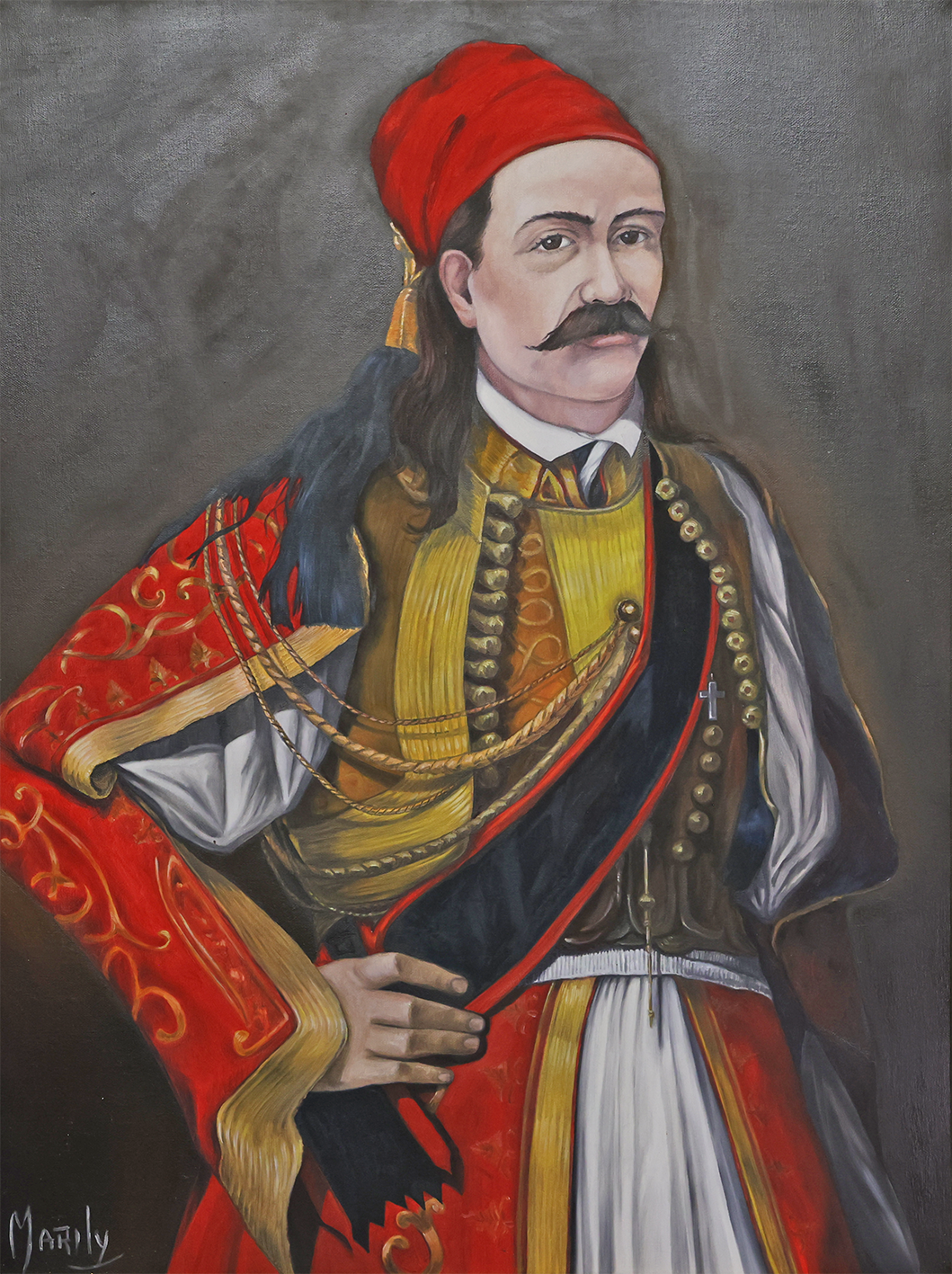
Portrait of Panos Kolokotronis
-
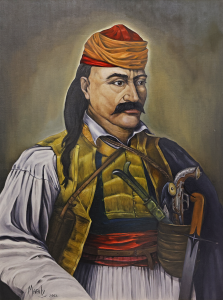
Portrait of Theodoros Kolokotronis