
Giorgos Rorris was born in Kosmas Kynourias in 1963. He studied Painting at the Athens School of Fine Arts with professors Panagiotis Tetsis and Yannis Valavanidis (1982-1987). He continued his studies at the École nationale supérieure des Beaux-Arts in Paris (1988 – 1991), with professor Leonardo Cremonini, with scholarships from the Basil and Elise Goulandris Foundation and the P. Bakalas Brothers Public Benefit Foundation. From 1996 to 2002 he collaborated with the “Center for Letters and Arts Aposisi” and then with the “Simeio” Art Group, teaching painting. In 2001 he was honored by the Academy of Athens with the Prize for a young painter under 40 years of age. In 2006 he received an honorary distinction from the “Alexander S. Onassis” Public Benefit Foundation. His works are in important public and private collections. He is an important representative of modern Greek figurative painting, whose works mainly depict interiors and female figures.
His work “Portrait of Theodoros Kolokotronis” is distinguished for its painterly and chromatic qualities. It is a portrait in which the artist has given particular emphasis to the gaze, facial features and weapons of the fighter, in addition to the posture and clothing. He himself states that he began the creation of the painting from the face of the General and wanted to convey the fact that he is a hardened person who had been through a lot in the Struggle. Rorris was inspired by this portrait by the engraving that previously adorned the five thousand drachma banknote. An intensity is discernible in Kolokotronis’ face, and he himself as a personality left a strong imprint as a legacy for future generations of Greeks. Rorris, with a strong gestural touch in his brushwork, presents the commander-in-chief as a dynamic and at the same time troubled figure rather than as an idealized hero of the revolution, as is usually portrayed by other artists, elements that bring him closer to reality. There is a strong gestural element in the brushwork on the face and in the costume of the Commander-in-Chief. Kolokotronis’s stance in a three-quarter turn towards the viewer magnetizes the gaze and conveys the inner state of the depicted.
-
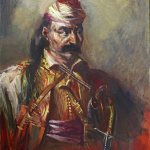
Portrait of Theodoros Kolokotronis